















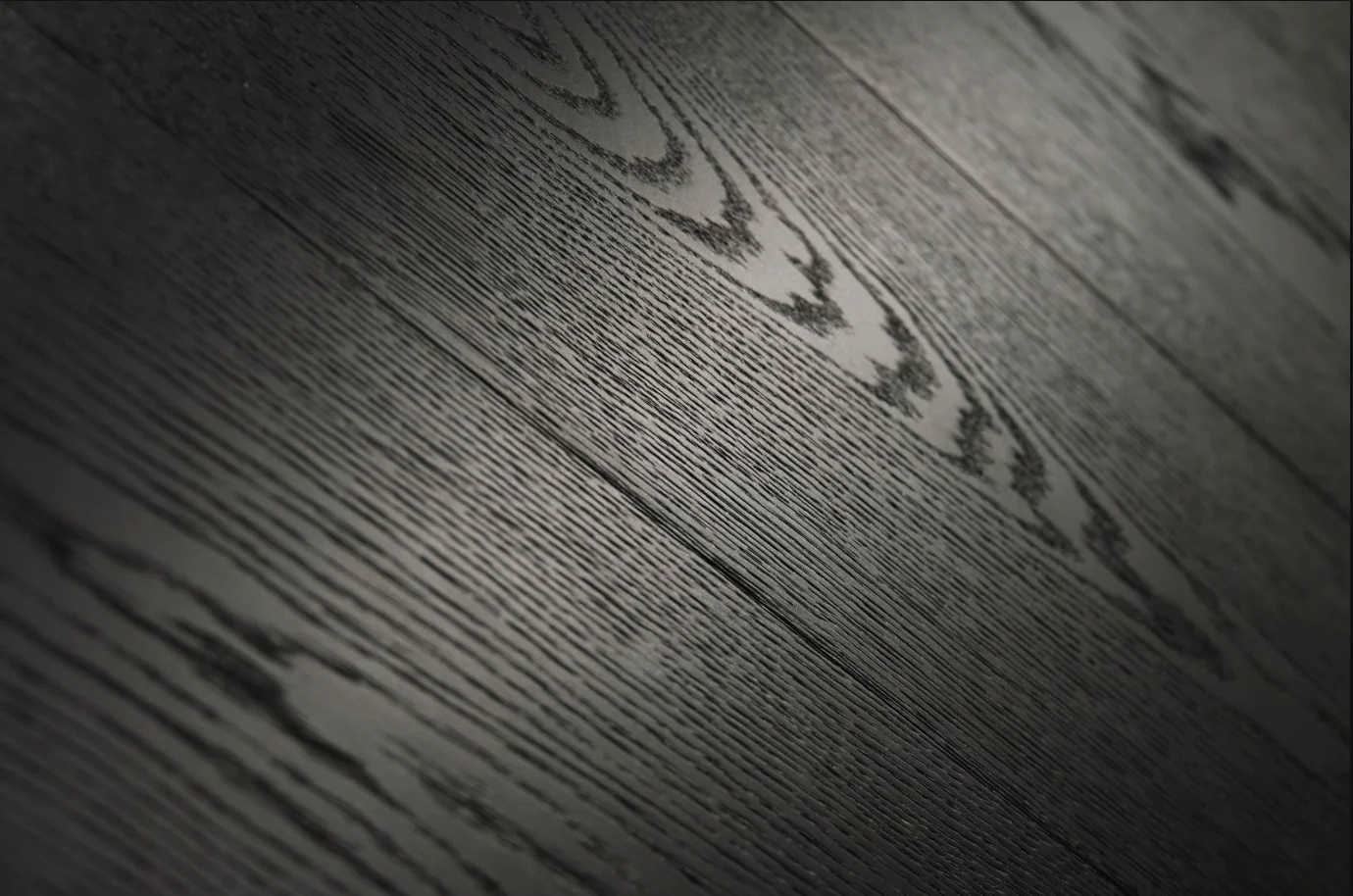
Dark wood flooring is not a single product. In HUAGE's original catalogue, Black Gentleman belongs to the 2400 × 300 mm long and wide board group, while Classic Black Oak is listed as a 610 × 55 × 16 mm narrow board. Both names suggest a dark atmosphere, but their actual formats and documentation differ. To compare them, first put the specific configurations in the same table.
Both follow an oak direction, with clearly distinct board dimensions
Black Gentleman's original page lists a European white oak face, Russian all-birch plywood core and 4.0mm top layer within the 2400×300mm group. Its chapter and detail pages state different overall thicknesses, 19mm and 16mm. Confirm current supply thickness rather than choose either value for convenience. Retain length, width and this thickness discrepancy together in the documents.
Classic Black Oak lists an oak face and all-birch plywood core without stating the same core origin. The board measures 610 × 55 × 16 mm with a 4.0 mm top layer. Similar top-layer figures do not erase length and width differences, or transfer the long and wide board group's core origin to narrow boards. Retain source fields for each design rather than reducing everything to 'black oak'.
Assess the dark colour scheme and joint rhythm together using samples
Long/wide and narrow boards create different joint densities within the same visible area. Draw partial assemblies using actual dimensions rather than comparing two photographs taken differently. Mark cabinetry, rugs and doorways first, then decide whether the priority is larger board faces or finer lines.
Black Gentleman's original group lists Italian water-based coating and handmade processing. Classic Black Oak mainly identifies an appearance direction and cannot inherit the same processing description. Compare colour, sheen and grain under identical lighting. Dark names are not universal colour codes and do not mean both designs look identical from every angle. Confirm each final surface configuration separately.
Do not combine floor and wall requirements into one item
The original Classic Black Oak page explicitly mentions wall applications, making it a reference for wall-to-floor colour comparisons. Black Gentleman flooring does not gain the same application scope through colour similarity alone. To extend a dark colour onto walls, list elevation, fixing and performance requirements separately and confirm available materials; a combined colour board cannot replace technical information for two different applications.
For enquiries, submit wide- and narrow-board candidates separately with sample identifiers, applications and drawings, marking outstanding thickness and configuration details. HUAGE's records locate products; current supply, transport and UK installation conditions require project confirmation. Distinguishing the designs grounds selection in format, material and application rather than one dark colour name.