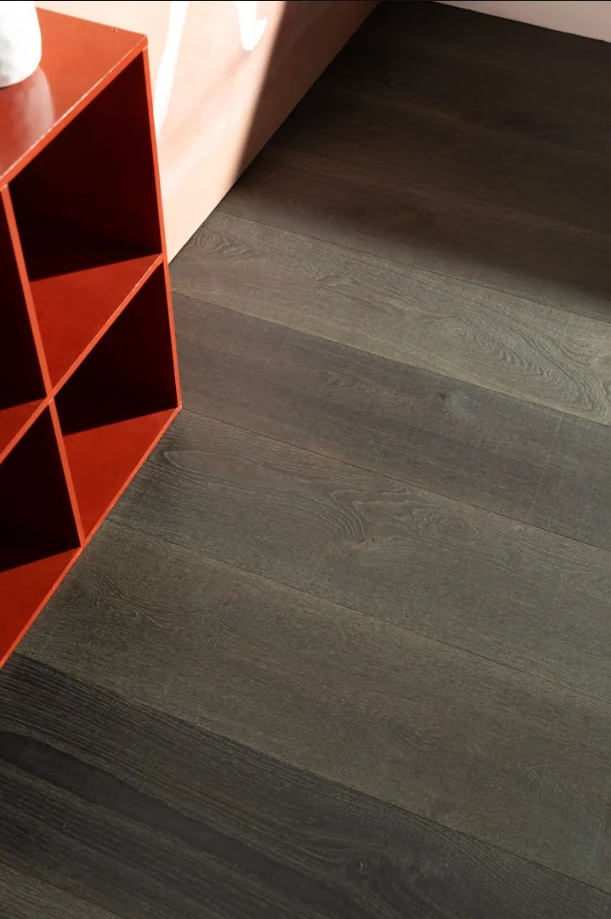
















In HUAGE's original catalogue, Champs-Élysées is a multi-ply engineered straight board with a European white oak top layer and Russian all-birch plywood core, measuring 1900 × 190 × 16 mm with a 4.0 mm solid wood top layer. This specific record illustrates why face material, core, construction and dimensions must be read together, rather than replaced by 'oak' or 'all-birch' alone.
Understand material layers through one catalogue plank
The original Champs-Élysées page lists European white oak, a Russian all-birch plywood core and multi-ply engineered construction, recording overall board specifications and solid wood top-layer thickness separately. Read these fields within one product record. 'Oak' alone omits the internal construction; 'all-birch plywood core' alone does not identify the visible species. Link supply information with sample cross-sections to avoid confusing similar names with identical configurations.
The top layer presents grain and finish; the core is another component of the board. This distinction helps installation and care questions, but a core name alone proves no heating, moisture or abrasion result. Confirm suitability against product, system and project rather than use one material term as complete technical information.
Keep samples aligned with supply information
When selecting samples, record the display name, face material, core, total thickness, top-layer thickness and finish on the back or in an accompanying schedule. If comparing oak and black walnut, record the face species change separately. Different thicknesses are not the same configuration merely because their colours match. Photographs help assess interior relationships; they cannot replace cross-section and specification confirmation.
Different original sources also define all-birch plywood within their own scopes. Some Catalogue A products explicitly state Russian all-birch plywood; some PDF products state only all-birch plywood and cannot inherit that origin. HUAGE retains each page's source scope in product descriptions. List this individually in enquiries, particularly across series, rather than extending one group's materials to every design.
Complete the use conditions for overseas projects
UK projects can first narrow selection using these material fields, then check subfloors, finished levels, connections and required documents with designers and local installers. Historical Chinese catalogues describe material combinations previously displayed; they cannot independently prove UK stock or compliance with local performance requirements. Separating selection references from local conditions supports further verification.
Final schedules should state each material's confirmation status: original catalogue information, physical sample approval or agreed supply. HUAGE's original names locate records; current specifications and delivery require project confirmation. Such records continue across design, purchasing and arrival checks, reducing repeated explanations based on abbreviations alone.